
English post
(pour mon lectorat francophone, billet 3 en 1 en anglais, pour faire une synthèse à l'intention des anglo-saxons de trois de mes précédents articles, écrits en français en dépit des titres :
* * *
What is Google RS2? (first guess)
What is Google Weaver? (second guess)
What is M Scrapbook? (last guess)
What is Google h9? (conclusion)
* * *
What is Google RS2?
In my opinion, the RS2 code name of Google means RSS (S² = two “S”), and it would be a web service that translates RSS feeds from blogs and podcasts from/into foreign languages, delivering “content served to a global readership through native language syndication”, as Nativetext:
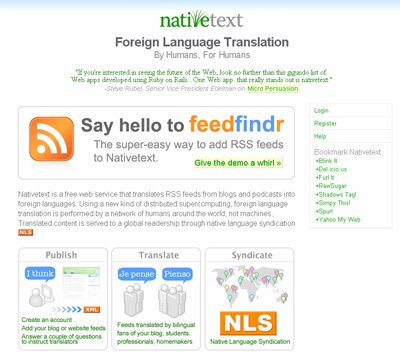
The difference : Nativetext is a social service (by humans, for humans), Google RS2 would be an automatic service, according to state of the art of Google in automatic translation (I think Google is first in this field). [Top]
* * *
What is Google Weaver?
According to Tony Ruscoe, who made the scoop, first the Google weaver ‘code name’ linked to a shown M Scrapbook login screen.
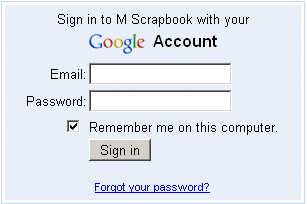
(changed from Sign in to M Scrapbook in Sign in to Weaver with your Google Account on 24 June 2006)
The he discovered than the Google weaver's links were pointing to google.com/h9.
No more information. [Top]
* * *
My first intuition was to associate h9 and HAL 9000, as we know the meaning of Hal 9000 for Google: The Ultimate Search Engine...
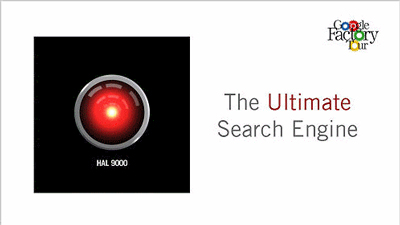
Google Inc. Factory Tour Slide no. 131, May 19, 2005.
Then, my second move was to google Weaver + HAL 9000, and I found this Wikipedia post, which states :
In the Futurama episode Love and Rocket, the actions of the lovestruck Planet Express Ship (voiced by Sigourney Weaver) extensively parody those of HAL in several scenes.Immediately I thought: Wow! I get it!
HAL is an artificial intelligence, the Supercomputer in 2001: A Space Odyssey, science fiction film directed by Stanley Kubrick. The screenplay was written by Kubrick and Arthur C. Clarke. [Top]
* * *
Hence I tried to discover a bit more about Google and Hal! My search returns a bunch of meaningful hits, of which this interview by Spencer Michels, reporting on the economic and technical success story behind the Google search engine.
Report and Video available here :
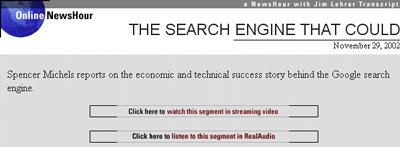
The transcript of Page & Brin's words gives us invaluable key points:
LARRY PAGE: And, actually, the ultimate search engine, which would understand, you know, exactly what you wanted when you typed in a query, and it would give you the exact right thing back, in computer science we call that artificial intelligence. That means it would be smart, and we're a long ways from having smart computers.
SPENCER MICHELS: Sergey Brin thinks the ultimate search engine would be something like the computer named Hal in the movie 2001: A Space Odyssey.
SERGEY BRIN: Hal could... had a lot of information, could piece it together, could rationalize it. Now, hopefully, it would never... it would never have a bug like Hal did where he killed the occupants of the space ship. But that's what we're striving for, and I think we've made it a part of the way there.
With these words of Sergey Brin, here I believe we get the precise explanation of the Weaver code name, associating the Hal bug and the Hal parody voiced by Sigourney Weaver. [Top]
* * *
But I havn't found yet the enigma of M Scrapbook. So I kept going on with searching, first on AI and Google, and I discovered a few excellent sources pointing out the dream stated by Larry Page at the Zeitgeist 06 Conference: AI could be a reality within a few years.
After all, Peter Norvig is also an artificial intelligence. Well, here are some of the words from Larry Page:
People always make the assumption that we're done with search. That's very far from the case. We're probably only 5 percent of the way there. We want to create the ultimate search engine that can understand anything ... some people could call that artificial intelligence.As it was explained to George Dyson visiting the Googleplex: “We are not scanning all those books to be read by people, (...)we are scanning them to be read by an AI.” [Top]
...a lot of our systems already use learning techniques.
* * *
Before writing these posts, I didn't know that “Artificial Intelligence: A.I.” was the last science fiction film project on which filmmaker Stanley Kubrick worked.
Kubrick had long planned to film A.I., but had been putting it off until he was confident that the effects could be handled convincingly, all the while working on the story in close cooperation with Steven Spielberg. After many years of exchanging ideas about the project Kubrick became convinced that this film needed Spielberg's "different kind of sensitivity" and urged him to direct the film. Spielberg finally accepted. Using Kubrick's storyboard, he wrote the script himself. The film is a unique harmony of both Kubrick and Spielberg's styles. It bears Kubrick's widespread use of metaphors and an ethereal score, along with Spielberg's warmth and subtle humor. Kubrick died before the film started shooting, and the film is dedicated to him.
 [Top]
[Top]* * *
Then my last intuition was to google Artificial Intelligence + Scrapbook, and here is the first result I get in the SERP:
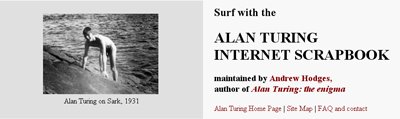
Everything became clear! It's not anymore the Rubik's Cube, but the Kubrick's Cube, with Google colours!

So now, what about Alan M. Turing?
Well, I think it's quite evident, since the Turing test was perfectly known to Stanford students.
And as we can read in Wikipedia: “The name "Turing Test" may have been invented, and was certainly publicized, by Arthur C. Clarke in the science-fiction novel 2001: A Space Odyssey (1968), where it is applied to the computer HAL 9000.”
Also, a common application of the Turing Test are the CAPTCHAs: Completely Automated Turing Test to Tell Computers and Humans Apart.
Last but not least, did you know that Vinton Cerf already received the A.M. Turing Award from the Association for Computer Machinery? [Top]
* * *
My last guess!
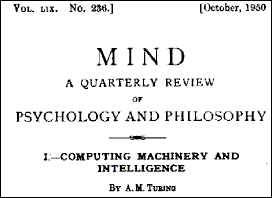
And now what about M in M Scrapbook ? M as Mathison (Alan Mathison Turing), M as Machine (Turing Machine), or simply M as ... Mind?
 [Top]
[Top]* * *
My title “Google h9, crack the code” was a nod in the direction of Alan Turing codebreaker, who succeed to crack the Enigma.
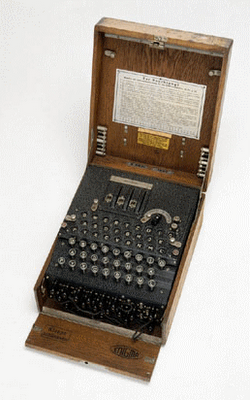
And now try to find who was involved in the dedicated site to Alan Turing :
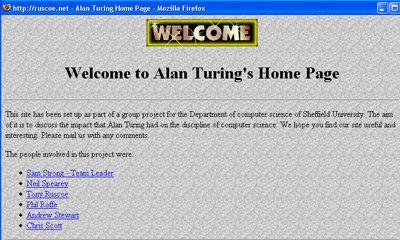
Conclusion:
the Google H9 code name stands for the ULTIMATE SEARCH ENGINE project!
As we said in french: “La boucle est bouclée” :-) [Top]
 Google, Weaver, AI, artificial intelligence, Google h9, h9, Hal 9000, Kubrick, Turing, Scrapbook, Ultimate Search Engine, Google RS2, RS2, translation, laboratoire de traduction, Internet


